
The Audi TT Custom Steering Wheel Guide
How to specify a custom steering wheel for an Audi TT, from the 8N and 8J to the 8S and TT RS: fitment, coverings, coding and what to check first.
Read More →Guide · 10/19/2026
Gloss and matte carbon share a weave and differ only in the top coat. How each finish handles light, dust and cleaning on an Audi rim, and which cars suit which.
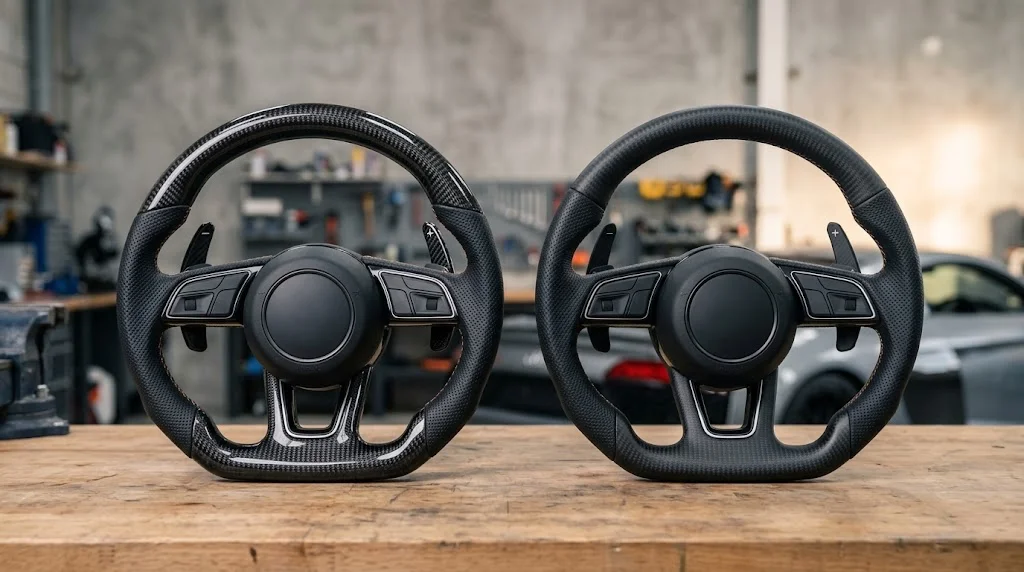
The two rims look like different products on a shelf. They are not. The two finishes share a weave, a core and a shape, and only the top coat separates them. This guide treats the Audi gloss vs matte carbon steering wheel question as a finish decision, then shows which Audi interiors reward which coat.
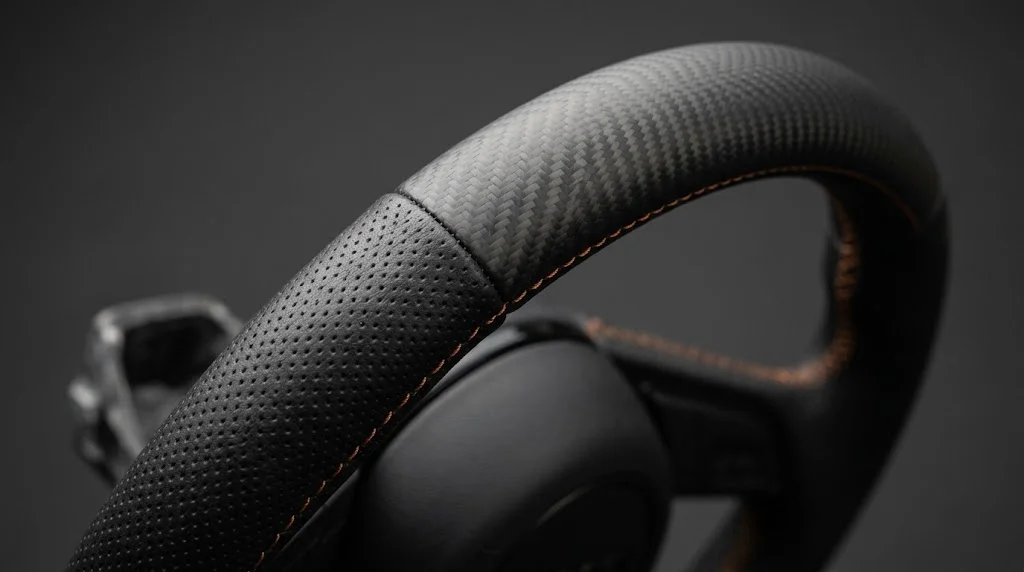
Carbon cloth is laminated into a shell, and the resin above the cloth decides how light behaves. A gloss layer is sanded and polished until the surface is flat, so light bounces off it in one direction. A matte layer is left textured at a microscopic level, so the same light scatters.
Nothing about strength, weight or fitment changes between the two. The core, the spoke layout and the mounting points are identical. What changes is how the rim looks at noon, at night, and after a week of street parking. Buyers ask which coat is more durable, and the answer sits in that thin top layer rather than in the cloth below it.
Gloss reads as depth. On a dark A6 or Q5 interior it pulls the eye to the rim, and the twill pattern shows sharp bands along the upper arc. Photographs flatter it, which is why show cars and press cars wear it.
The same flat surface shows everything else. Dust settles in a visible film within days, and fingerprints collect where hands cross the twelve o'clock arc. Low winter sun finds swirl marks that a matte coat would hide entirely. Owners who wash their own car tend to notice this first.
Matte behaves like a satin shirt. Light sinks into it instead of bouncing off, so the rim reads as a dark shape rather than a bright object. The weave shows only when the eye is close. Dust disappears into the texture, and a dry cloth brings it back.
For an A3 or A4 parked on a street, that difference matters more than any brochure photo. The texture also ages quietly, because there is no polished layer to dull under ultraviolet light. The trade is a softer look that some buyers find less dramatic.
| Attribute | Gloss | Matte |
|---|---|---|
| Light | Reflects, reads deep | Absorbs, reads even |
| Dust and prints | Show within days | Largely hidden |
| Swirl marks | Visible in low sun | Barely visible |
| Sun over years | Polish can dull | Stable |
| Cleaning | Wipe, then buff | Wipe only |
| Usual owner | Garaged car, dark cabin | Daily car, street parking |
The columns are not a ranking. The table exists so the choice can be made on the car's routine rather than on a photograph. For the Audi gloss vs matte carbon steering wheel build, that one detail decides more of the finished look than the weave does.
Weave choice changes the picture as much as the coat does. A twill weave gives clear diagonal bands. A gloss coat makes those bands shimmer, while a matte one softens them into a dark grid. Forged carbon carries no visible weave, only a marbled chip pattern. Coated in gloss it reads like wet stone. Left matte it sits close to plain dark grey.
An R8 or TT owner often wants the weave to be seen, which points to gloss twill. A family Q5 with a light grey interior tends to suit forged carbon in matte, because there is no pattern to fight the trim. The choice does not change how the rim feels in the hand, and the stitching is the same either way.<\/p>
A B9 A4 or A5 that covers motorway miles usually looks better in matte. The car lives outside and the rim is touched every day. The same body with a garage and a weekend habit can carry gloss without the upkeep becoming a chore. Parking decides more of this than the badge does.
An 8Y A3 with the S line trim has plenty of dark plastic around the wheel. Carbon in gloss adds the one bright note the cabin lacks. On a C8 A6 or A7 the screens already reflect light, so a matte coat keeps the rim from competing with them. TT and R8 cabins pull the other way. A gloss finish belongs there, because that car is bought for how it looks standing still.
Send the chassis code, the model year and a photograph of the rim in daylight. A second shot of the rear face, with the airbag removed, tells us more than any catalog listing.
Trim level decides the airbag, and the airbag decides the cover. An S line car and a standard car of the same year can carry different bags, different button frames and different connector shapes. Paddle shifters, a heated rim and the driver assistance pack each add parts behind the cover. Right hand drive cars differ again. We ask for the pictures because a catalog line will not settle it, and nothing is cut before the match is confirmed.
The finish should be the only thing that changes. Our builds reuse the frame, the buttons and the wiring that came with your car.
| Control | Typical outcome |
|---|---|
| Airbag | Original unit reused, cover shaped to suit it |
| Multifunction buttons | Kept when the original frame is reused |
| Paddle shifters | Kept; openings set at order |
| Heated rim | Depends on the mat and control fitted; confirm first |
| Lane assist and adaptive cruise | Read hardware in the rim, so a swap can raise a message |
| Drive select button | Kept where the wheel carries one |
The heating mat sits behind the covering, and the hands-on sensor sits beside it. Both need their own photograph before an order moves forward.
Programming follows the electronics, not the finish. Keep the factory module, the loom and the car-specific parts, and the car may need nothing further. Move to a unit from a different generation and the answer can change.
Because that depends on the car in front of us, coding is offered as a possible step. Send the chassis code with pictures of the module and the connector, and we will say whether a workshop visit looks likely. A heated rim fitted to a car that never had the option is the common case that needs one.
Trouble on these cars usually arrives with the parts, not the coat. A rim from another generation carries the badge and not the button frame. A heated wheel on a car without the option leaves a connector doing nothing. Assistance systems read hardware inside the factory rim, so a swap can bring a warning to the dash. A cover cut for one airbag shape will not sit on another. Photographs catch each of these before production.
Gloss wants a microfibre cloth, a little mild soap and a dry buff. It wants them before dust turns into a film. A matte coat takes the same cloth with less water and no polish at all. Wax or compound leaves a shiny patch on that texture which cannot be blended back.
Two habits protect both coats. Park with the rim out of direct sun where that is possible. Keep rings and keys away from the lower spokes during a turn. No habit there costs anything, and each one stretches the years a finish stays even. The lower spoke takes more knocks than the top arc. That is the part of the Audi gloss vs matte carbon steering wheel which ages first.
No. A matte coat hides fine marks that gloss would show, and both resist the same everyday contact.
Only by refinishing the shell, which is a workshop job rather than a wipe-on product. A fresh cover is usually the cleaner route.
A polished coat can dull under years of direct sun. A matte finish holds its appearance longer, and a sunshade helps either one.
It is easier. A dry microfibre cloth handles dust, while gloss needs a wet wipe and a buff to look even again.
The two coats sit inside the same build range. The quote depends on the rim, the weave and the extras rather than on the top layer.
Often yes, when the mat and its control are reused. Build years differ, so it has to be checked against your car.
The workshop needs ten to fifteen working days, transit adds fifteen to twenty days, so twenty-five to thirty-five days in total.
For a car that is handed back or sold on, a matte finish is the safer pick. It hides wear and asks for less attention between washes, so the rim still looks cared for at handover.
Every shell is laid up, cut and stitched to one car in our Guangzhou workshop. Our patterns rest on thirteen or more years of design and production. Finish, weave and stitch stay your calls. An aftermarket steering wheel does not automatically void a vehicle warranty under U.S. federal warranty law, but warranty coverage can still depend on whether the modification caused the specific failure being claimed. The federal remedy rules appear in 15 U.S.C. 2304, and the warranty-term rules in 16 CFR part 700.
Three pages on this site carry the Audi story further. The A4 B9 and A6 C8 guide covers the two most common chassis we build. The TT guide deals with the smaller cabin and its airbag. The shop lists every finish we offer.
Tell us which coat you are leaning towards, add the chassis code and the option list, and send a photograph of the rim. A confirmed build and a date come back before the shell is laid up. Two catalog entries show the range. One is the matte carbon rim listed across the A3, A4, A5, Q3 and Q5. The other is the gloss RS-style rim with Alcantara grips. Fitment questions can go to the inquiry form or the contact page, and the Audi brand page lists every chassis we cover.
How to specify a custom steering wheel for an Audi TT, from the 8N and 8J to the 8S and TT RS: fitment, coverings, coding and what to check first.
Read More →How to specify a custom steering wheel for an Audi R8, from the Type 42 to the Type 4S and the V10 cars: fitment, coverings, coding and installation.
Read More →How to specify a custom steering wheel for an Audi A8 or S8, from the D3 and D4 to the D5 and A8 L: fitment, wood and leather, coding and installation.
Read More →